Normal
0
false
false
false
EN-US
X-NONE
X-NONE
MicrosoftInternetExplorer4
/* Style Definitions */
table.MsoNormalTable
{mso-style-name:”Table Normal”;
mso-tstyle-rowband-size:0;
mso-tstyle-colband-size:0;
mso-style-noshow:yes;
mso-style-priority:99;
mso-style-qformat:yes;
mso-style-parent:””;
mso-padding-alt:0in 5.4pt 0in 5.4pt;
mso-para-margin-top:0in;
mso-para-margin-right:0in;
mso-para-margin-bottom:10.0pt;
mso-para-margin-left:0in;
line-height:115%;
mso-pagination:widow-orphan;
font-size:11.0pt;
font-family:”Calibri”,”sans-serif”;
mso-ascii-font-family:Calibri;
mso-ascii-theme-font:minor-latin;
mso-fareast-font-family:”Times New Roman”;
mso-fareast-theme-font:minor-fareast;
mso-hansi-font-family:Calibri;
mso-hansi-theme-font:minor-latin;}
You live in New Delhi, the capital city of the great nation
of India. You use public transport whenever possible, either for financial
reasons or simply because you are trying to reduce your carbon footprint. You
have the auto-rickshaw if you are in a hurry or traveling to poorly connected
areas or carrying a large package. You have the metro to travel across the city
in a delay-free, air-conditioned environment, with the assurance of reaching
your designated metro station. Last but the most important, you have the bus
service, and here you will re-read the title and probably nod your head in
agreement. For those of you not in or from New Delhi, allow me to share.
CNG buses for service in the City and National Capital Region. There are plying
on about 773 routes to cover as much of the city and towns as possible by road.
On top of this you have the private chartered bus services and feeder buses at
metro stations. Mind you, these buses are an option from all the other means
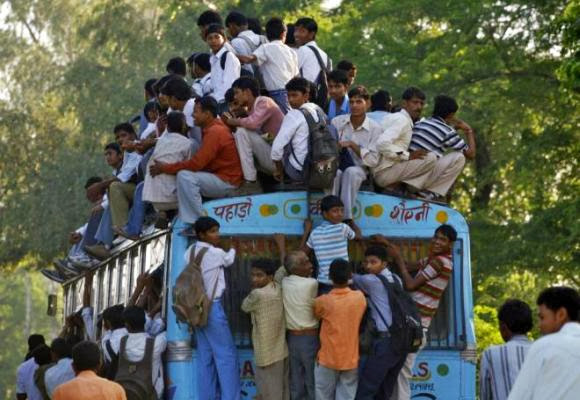
of public transport stated earlier, yet during rush hours, you will find near
all of those buses, overcrowded and overflowing. Only recently did the DTC introduced
the low floor buses with automated doors, and air conditioning in nearly half
of them, and hence have discouraged people to travel hanging by the doors.
There is a law against overcrowding in buses but private charters rarely obey,
and contractual workers for the DTC are always greedy to earn more. Hence,
those buses have people clambering over each other so as not to fall out of the
damn bus, which is meanwhile being driven wildly around at speeds of 40-50 km/h.
This crowd behavior is further encouraged by the calls of the bus conductor
much to the discomfort of the passengers already on board.
pay the fare and buy the ticket as proof of payment. In the low floor bus
design, the conductor is seated on a high seat, right next to the boarding
doors at the back, like a throne, making it easier for him to collect fares and
distribute tickets in the sea of flailing arms. In the private and feeder buses however, the conductor goes from seat to seat, collecting fares, calling
out to the people waiting at bus stands to board the bus, making empty promises
of the space inside the bus. In a overcrowded country like India, most of the
lower economy class people have a habit of traveling squished up against other
people’s armpits and will climb into that minuscule gap, smiling as if it were
an achievement to be proud of.
sufficient space, it is extremely frustrating and infuriating when the damn
conductor keeps calling to people to get on the bus, asking those inside to ‘kindly
adjust’ to accommodate them, and refuses to move until he has new passengers,
hence delaying you, the one who was already on board, from reaching their
destination.
conductor, and blaming his ‘kind’(conductors) for half of the transport
problems in the city (which they probably are),
contemplating on horrific endings for him should you be given the
chance. Pushing him off into the traffic is tempting as he leans out the door, scanning
for possible victims waiting for a bus, seems to be the most popular and
realistic execution of this evil doer. But then the rational mind kicks in and
peace and silent hatred is maintained.
in those conditions, to kill the damn conductor.